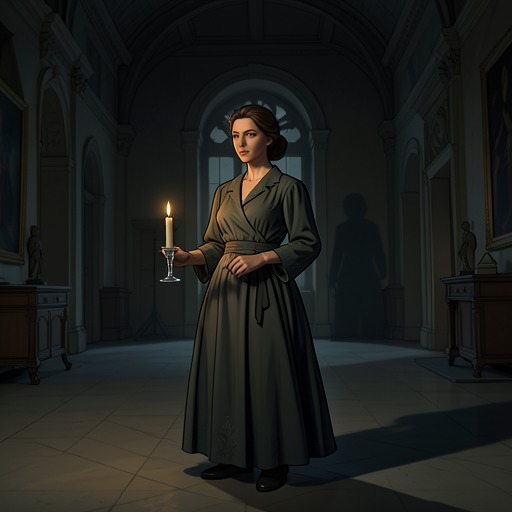
Murder of the Baroness de la Chalonnière
The Day of the JackalThe Murder of the Baroness de la Chalonnière is the point at which The Jackal’s concealed assassination preparations become visible to someone close to him. When Colette discovers the disassembled rifle in his luggage and recognizes his purpose, he kills her rather than allow her to expose him. Her death sends the police investigation into a new phase: the search is no longer only for a political assassin, but also a nationwide hunt for the man who has murdered the owner of the château.
Causes and Discovery
The murder takes place at the Château de la Haute Chalonnière, where The Jackal has been staying with Colette. He had hoped to remain for two more days, but a telephone call forced him to leave sooner. After hanging up, he recalled hearing a soft click on the line, unlike anything he had noticed during the previous three days. He suspected that someone might have been listening, and went upstairs to investigate.
In the bedroom, the wardrobe stood open and all three suitcases had been emptied onto the floor. The keys to the cases lay nearby. Colette was among the scattered contents, holding the barrel and breech of the rifle. Slim steel tubes lay around her; one exposed the telescopic sight and another the silencer. The weapon, which The Jackal had hidden as separate components, was no longer an abstract suspicion but an assembled set of clues in the hands of a witness.
Colette recognized what the parts meant. She understood that The Jackal intended to kill de Gaulle and identified him with the OAS. His silence confirmed her conclusion. The murder follows directly from that discovery: she tried to run for the door, and he seized her before she could escape.
The Killing and Escape
The Jackal threw Colette onto the bed and struck her at the side of the neck, choking off her scream. He then dragged her down over the edge of the bed and struck the back of her neck. The doctor who examined her later confirmed that her neck had been broken. The scene’s abrupt reversal is decisive: a private discovery of the weapon becomes a killing, and the woman who had shared the château with The Jackal is left dead while he prepares to disappear.
He paused to listen for anyone downstairs. Ernestine was in the kitchen preparing the morning rolls and coffee, while Louison was expected to go to market; both were hard of hearing. The Jackal then repacked the rifle components into their tubes and returned them to the third suitcase, among the army greatcoat and soiled clothes associated with André Martin. He checked that the papers in the lining had not been disturbed. The second case, containing the clothes of Per Jensen, had not been searched.
His departure depended on transforming himself as well as removing the weapon. After washing and shaving, he cut two inches from his long blond hair, dyed it iron-grey, and brushed it into the style shown in Per Jensen’s passport. Blue-tinted contact lenses completed the change. He cleaned away the traces of the hair dye and washing preparations, collected his shaving things, and left Colette’s naked body on the floor. Then he dressed as a Danish pastor, adding the black bib and dog collar, and packed the passport and money he needed. The murder had given him a narrow interval in which to conceal the evidence and resume his journey under another identity.
Discovery and Police Response
Louison eventually found Dr Mathieu, who had tended to people in the area for more than forty years. The doctor arrived at the château after half past four; fifteen minutes later, he told the two retainers that Colette was dead and that her neck had been broken. The local constable took statements from Ernestine, Louison, and the doctor around the kitchen table. He concluded that a murder had been committed and identified the missing blond Englishman, who had left in the Baroness’s car, as the first suspect. He reported the case to headquarters in Egletons.
The news reached Claude Lebel through Commissaire Valentin. When Valentin confirmed that the dead woman was the owner of the château, the Baroness de la Chalonnière, Lebel immediately recognized the connection to the fugitive he was pursuing. He ordered a general alert and explicitly ended the secrecy surrounding the investigation: it was now a straightforward murder hunt. He also directed the police to follow the trail from the château and determine the fugitive’s direction of flight. The discovery of Colette’s body thus changed the public and procedural character of the search, giving the authorities a local crime scene and a missing car to pursue.
Significance in the Manhunt
Before the murder, Lebel’s investigation had proceeded under exceptional secrecy. He had been told that the assassin might still be in France, but the police did not know under which new identity to locate him or how far along his private timetable he had progressed. Evidence from records and enquiries had begun to connect the fugitive with the name Alexander Duggan; Lebel also suspected that a warning had reached The Jackal after police uncovered that identity. The murder at the château confirmed that the assassin was still moving and willing to continue despite the investigation closing in.
The authorities now had to combine the murder inquiry with the effort to prevent an attack on de Gaulle. Lebel later recognized that The Jackal’s apparent delay after leaving Gap was not evidence that he had abandoned his plan: he had chosen a particular day to strike. Meanwhile, the fugitive’s disguises continued to complicate the search. At a checkpoint, a guard reported allowing an apparently ill, older cripple through a gap in the street closure after the man showed identification and a war-disabled veteran’s card. The murder did not end The Jackal’s preparations; it marked the moment when his violence became legible to the police, while his disguise still allowed him to pass through the very security measures meant to stop him.